CE marking for pressure equipment done! With easyCE expert support.


Define the right conformity route for your pressure equipment. easyCE reviews the design, fluid group and category, coordinates the required technical assessment and prepares the documentation and declaration of conformity where CE marking applies.
Willy Lebherz
Founder and Managing Director of easyCE GmbH

DoC ready to sign!
We prepare your declaration of conformity, ready for the responsible signatory.
Risk assessment completed!
We assess the relevant product risks and document the findings.
Applicable standards identified!
We identify the relevant harmonised standards and check their scope, current references and any restrictions for your product.
Technical documentation created!
We prepare clear technical records and practical instructions for your product.
Ready for CE marking!
Once conformity has been demonstrated, the manufacturer signs the declaration and affixes the required marking.
Your role. Your CE responsibilities.
Manufacturers
The Pressure Equipment Directive 2014/68/EU covers the design, manufacture and conformity assessment of pressure equipment and assemblies with maximum allowable pressure PS above 0.5 bar, subject to its exclusions. Examples include vessels, piping, safety accessories and pressure accessories.
Not every item above 0.5 bar requires CE marking under the PED. Equipment below or at the relevant Article 4 thresholds follows sound engineering practice. For equipment requiring CE marking, the fluid, pressure, volume or nominal size determine the category and available assessment modules.
easyCE reviews the pressure specification, materials, drawings and intended use. We classify the equipment, identify the required evidence and prepare the agreed assessments and technical records. Where the selected route requires it, we coordinate the technical input for the notified body.
Frequently asked questions
What is the Pressure Equipment Directive?
Directive 2014/68/EU, known as the PED, sets requirements for pressure equipment and assemblies within its scope. Most provisions have applied since 19 July 2016, replacing Directive 97/23/EC.
It covers products new to the EU market, including new products made in the EU and new or used products imported from outside it. Manufacturers, authorised representatives and importers have distinct duties; these roles are not interchangeable.
What does the PED aim to achieve?
The PED supports the free movement of compliant pressure equipment and assemblies while providing a high level of safety against pressure hazards. Member States may not create additional market-access barriers concerning matters harmonised by the directive.
Which products are covered?
Pressure equipment includes vessels, piping, safety accessories and pressure accessories with maximum allowable pressure PS above 0.5 bar, subject to the scope conditions and exclusions. Assemblies are several items integrated by a manufacturer into a functional whole.
- Pressurised storage vessels and industrial piping.
- Heat exchangers.
- Shell boilers, water-tube boilers and steam generators.
- Safety valves and other protective accessories.
- Pressure accessories such as valves and regulators.
Attached elements such as flanges, nozzles and couplings can form part of the pressure equipment.
How does the PED relate to national operating rules?
Member States can set requirements to protect people, particularly workers, when pressure equipment is used, provided these do not require product changes contrary to the directive. Installation, inspection and operating duties must therefore be assessed separately from the initial product conformity assessment.
When must the PED be considered?
Consider the PED during design and before manufacture, procurement or import. It applies to the design, manufacture and conformity assessment of in-scope equipment and assemblies. Classification and the selected assessment module affect the evidence, production controls and third-party involvement needed before market entry or own use.
Which products are excluded?
Article 1 contains detailed exclusions and qualifications. The following overview groups the main cases; each exclusion must be checked against the actual product:
- Specified transport pipelines and water supply or distribution networks, including certain hydropower conduits. Standard pressure equipment at pressure-reduction or compressor stations is not automatically excluded.
- Simple pressure vessels, aerosol dispensers, specified vehicle equipment and certain transportable pressure equipment covered by their own legislation.
- Equipment no higher than Category I that is covered by the listed machinery, lift, electrical, medical-device, gas-appliance or ATEX legislation.
- Specified defence and nuclear equipment, well-control equipment and machinery in which pressure is not a significant design factor.
- Specified metallurgical furnaces, high-voltage electrical enclosures and pressurised enclosures for transmission systems.
- Ships, aircraft, rockets and mobile offshore units, including equipment specifically designed for their installation or propulsion.
- Flexible-casing products such as tyres, air cushions and inflatable boats, plus exhaust and intake silencers.
- Certain beverage containers, including those within the specified pressure and pressure-volume limits.
- Hot-water heating radiators and pipes, and liquid-containing vessels with gas pressure above the liquid no greater than 0.5 bar.
Does the PED apply to an industrial installation?
The PED applies to individual pressure equipment and to assemblies supplied as integrated functional wholes by a manufacturer. It does not generally cover an industrial installation assembled on site under the user's responsibility in the same way as a manufacturer-supplied assembly.
The location of assembly alone is not decisive. Identify who controls the integration, what is supplied and who takes manufacturer responsibility. The individual equipment and national installation or operating requirements still need assessment.
What requirements apply to my equipment?
Equipment and assemblies above the relevant Article 4 thresholds must meet the essential safety requirements, complete the applicable conformity procedure and carry CE marking and the required information.
Equipment covered by Article 4(3) must be designed and manufactured in accordance with sound engineering practice and supplied with adequate instructions and identification. It must not carry CE marking under the PED, although other applicable legislation may require CE marking.
What does CE marking mean?
CE marking indicates that the manufacturer has demonstrated conformity with the applicable EU legislation requiring the marking. Under the PED, it applies to equipment and assemblies subject to the relevant conformity assessment provisions, not to all pressurised products.
What demonstrates conformity?
Conformity is supported by the applicable assessment procedure and technical documentation, including design records, risk assessment, material evidence and test results. The manufacturer issues the EU declaration of conformity. Importers must ensure documentation can be made available to authorities; commercial partners do not automatically have a right to the complete technical file.
How is conformity maintained?
The manufacturer must control design and production, review relevant changes and take action when equipment is found not to comply. Documentation must reflect the supplied product and remain available for the required period. easyCE reviews existing records and identifies the assessment or documentation gaps that need to be resolved.
Can other legislation apply alongside the PED?
Yes. An assembly may also fall under machinery, electrical, EMC, ATEX or other product legislation. Scope and exclusions must be considered together. The repealed Directive 97/23/EC is not an additional current requirement for a new PED project. easyCE identifies the applicable legislation for the particular equipment and supply arrangement.
What does Regulation (EC) No 765/2008 cover?
Regulation (EC) No 765/2008 sets rules for accreditation and general CE-marking principles. Market-surveillance provisions must also be read in the context of Regulation (EU) 2019/1020. These horizontal rules do not replace the PED's product-specific assessment requirements.
Where are the essential safety requirements?
The PED's essential safety requirements are in Annex I. They address design, manufacture, materials, final assessment, marking and instructions, with additional requirements for particular types of equipment. The assessment must identify the relevant hazards and show how the applicable requirements are met.
What is the role of Decision No 768/2008/EC?
The decision provides common model provisions for EU product legislation, including economic-operator duties, assessment modules and notified-body arrangements. It informed the recast PED. A manufacturer follows the applicable provisions of Directive 2014/68/EU, rather than treating the decision as a separate product certification procedure.
How does chemical classification affect the PED?
Article 13 divides fluids into Groups 1 and 2 using specified hazard classifications under the CLP Regulation (EC) No 1272/2008. This grouping affects the equipment category and assessment route.
Use the actual substance or mixture classification and its conditions of use. The term fluid includes gases, liquids and vapours; it does not mean liquids only.
What makes pressure equipment safe?
Annex I requires an assessment of the relevant pressure hazards and suitable design, manufacturing and protective measures. Important evidence includes:
- Design calculations and protection against exceeding allowable limits.
- Suitable materials and material certificates or appraisals.
- Qualified permanent-joining procedures and personnel, with third-party approval where required.
- Suitable non-destructive testing and qualified personnel.
- Final inspection and proof testing, normally including a hydrostatic pressure test unless a justified alternative is permitted.
How do harmonised standards help?
A harmonised standard whose reference is published in the EU Official Journal can provide a presumption of conformity for the essential requirements it covers. Standards are voluntary, and applying one does not automatically establish conformity with every requirement. Alternative solutions need appropriate technical evidence.
How is the conformity route selected?
Equipment requiring PED CE marking is classified from Category I to IV in increasing order of hazard. The manufacturer selects an available procedure for the category or, where permitted, a higher-category procedure. The choice determines design assessment, production controls and third-party involvement.
What is a notifying authority?
A notifying authority is the national authority responsible for assessing and notifying conformity assessment bodies and monitoring the relevant bodies. It is distinct from a notified body, which performs the specified assessment tasks for a manufacturer.
When is third-party involvement required?
The standard CE-marking routes for Categories II, III and IV involve a notified body. Category I uses internal production control. Approval requirements for permanent joining and non-destructive-testing personnel depend on the category and task.
For Categories II to IV, permanent-joining procedures and personnel need approval by an appropriate notified body or recognised third-party organisation. Separate, restricted provisions exist for assessments by user inspectorates; equipment assessed under that route does not receive CE marking under the PED.
What tests are required?
Testing follows the equipment design, hazards, category and selected module. It includes the final assessment and relevant inspections or proof tests, not merely random sampling. Where appropriate to product risks, manufacturers must also investigate complaints and sample equipment already made available, keep relevant records and take corrective action.
How does experimental design verification work?
An appropriate test programme can validate a design wholly or partly where the PED permits this approach. The programme must be defined before testing and accepted by the notified body responsible for design assessment, if one is involved.
Set the conditions and acceptance criteria, measure the relevant dimensions and material properties, and use suitable instrumentation to observe critical behaviour. The test sample must represent the equipment or equipment category being assessed.
What does notified-body surveillance cover?
The scope depends on the selected module. It may involve individual verification, supervised product checks or assessment and surveillance of an approved quality system.
For quality-assurance modules, the manufacturer provides access to relevant premises, technical records and quality reports. The notified body conducts periodic audits and may make unexpected visits or arrange tests. Audit frequency and reassessment requirements follow the selected module and approved surveillance arrangements.
Can a notified-body decision be appealed?
Yes. Appeal procedures must be available for decisions of notified bodies, recognised third-party organisations and user inspectorates. Request the decision and its reasons in writing and follow the applicable appeal procedure.
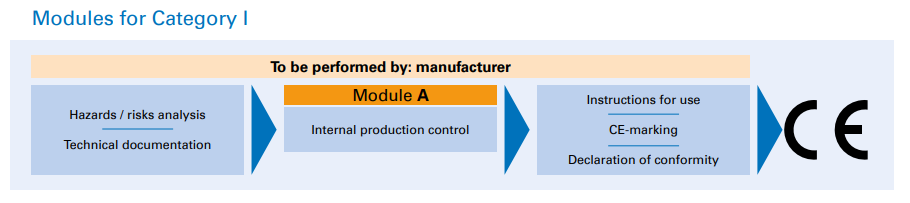
What applies to Category I equipment?
Category I uses Module A, internal production control. The manufacturer prepares the technical documentation, ensures manufacture meets the applicable requirements and issues the declaration before affixing CE marking. A notified body is not required by this module. easyCE prepares or reviews the agreed technical evidence.
What are the classification steps?
A structured classification starts with the product and operating conditions:
- Identify the equipment type and check exclusions.
- Determine whether the fluid is treated as a gas or liquid.
- Identify Fluid Group 1 or 2.
- Select the applicable Annex II table.
- Use PS and volume or nominal size to establish the category.
- Select an available conformity assessment module.
How is the equipment type defined?
The PED distinguishes several product types and assemblies:
- Vessels: housings designed to contain fluids under pressure, including direct attachments up to the connection point.
- Heated equipment: relevant fired or otherwise heated equipment for generating steam or superheated water above 110°C with volume above 2 litres, and pressure cookers.
- Piping: connected components for transporting fluids in a pressure system, such as pipes, hoses, fittings and expansion joints. Certain air-heating or cooling tubular heat exchangers are treated as piping.
- Safety accessories: devices protecting equipment against exceeding allowable limits, including relief devices and appropriate limiting devices.
- Pressure accessories: devices with an operational function and a pressure-bearing housing.
- Assemblies: several items integrated by a manufacturer into a functional whole.
How are gases and liquids distinguished?
For PED classification, liquids with vapour pressure at the maximum allowable temperature more than 0.5 bar above normal atmospheric pressure are treated in the gas group of the relevant table. For multiple fluids, assess the fluid that leads to the highest category. Use the actual design temperatures and fluid data.
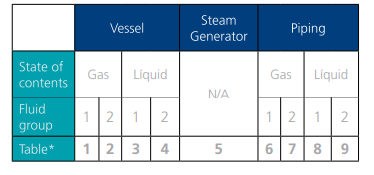
Which classification table should be used?
Select the appropriate Annex II table using the equipment type, fluid group and whether the fluid is treated as a gas or liquid. Check all table notes and special provisions, not just the plotted boundary lines.
How is the category read from the table?
Use maximum allowable pressure PS with volume V for vessels, or nominal size DN for piping, as appropriate. Boundary lines in Annex II indicate the upper limit of each category. Pressure accessories use volume or DN as appropriate; if both are relevant, use the higher category.
Safety accessories are generally Category IV, with a specific exception for accessories manufactured for particular equipment. Assemblies require an overall assessment of the component items, integration and protection against exceeding limits; a single category label does not replace these checks.
Which modules are available by category?
Annex II provides the following standard module choices:
- Category I: A.
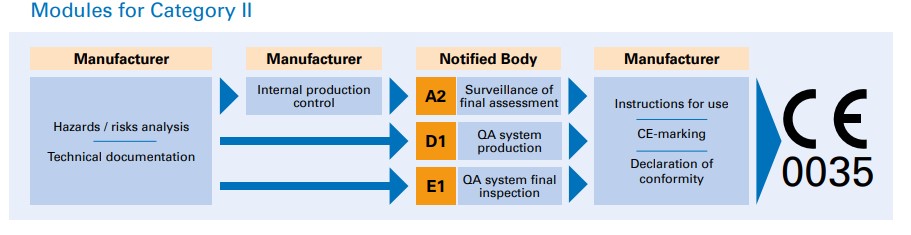
- Category II: A2, D1 or E1.
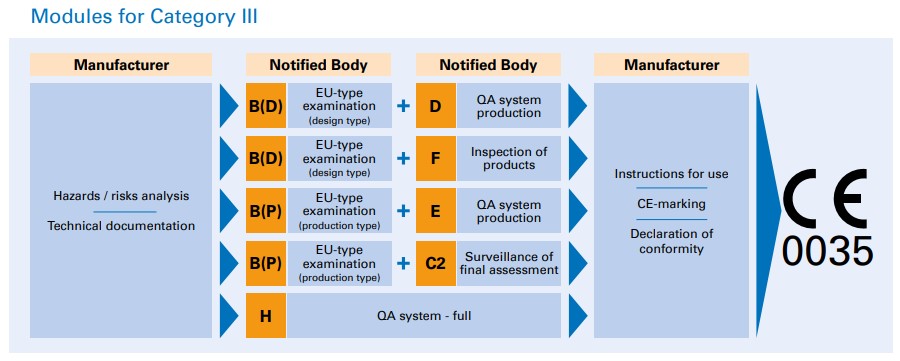
- Category III: B (design type) + D or F; B (production type) + E or C2; or H.
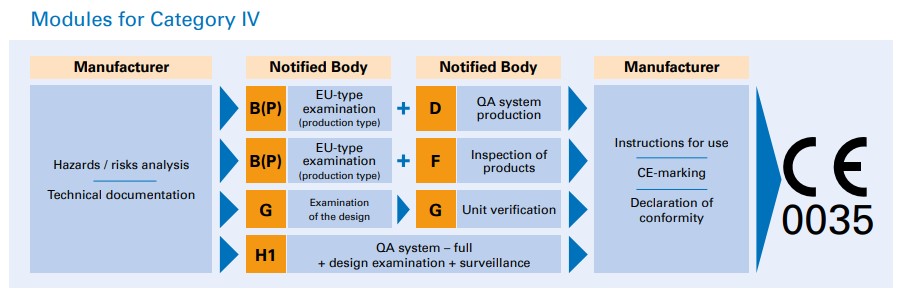
- Category IV: B (production type) + D or F; G; or H1.
A manufacturer may select an available higher-category procedure where the directive permits it.
What are Modules A and A2?
Module A is internal production control, carried out under the manufacturer's responsibility. Module A2 adds supervised pressure-equipment checks at random intervals by a notified body. Both require appropriate technical documentation and control of manufacture.
What is Module B, production type?
EU-type examination of the production type combines assessment of the technical design with examination of a representative production sample. The notified body assesses whether the type meets the applicable PED requirements. A corresponding production-stage module is also needed.
What is Module B, design type?
EU-type examination of the design type assesses the technical design through the documentation and supporting evidence, without examining a production sample. It must be combined with an available production-stage module. It is not the same procedure as production-type examination.
What is Module C2?
Module C2 addresses conformity to the approved type through internal production control and supervised pressure-equipment checks at random intervals. The manufacturer maintains conformity to the type described in the EU-type examination certificate, while the notified body performs the required supervision.
How do Modules F and G differ?
Module F is conformity to type based on pressure-equipment verification, used with the relevant Module B approval. Module G is conformity based on unit verification and assesses the individual product without a separate Module B stage.
The notified body examines the relevant records and carries out or arranges the required inspections and tests. Neither route should be described simply as a generic laboratory certificate.
What are the quality-assurance modules?
Modules D and D1 focus on production-process quality assurance; E and E1 focus on quality assurance of final inspection and testing. Modules H and H1 use full quality assurance, with additional design examination and final-assessment surveillance under H1.
The selected system must meet the PED module requirements and be assessed by a notified body. An ISO 9001 certificate alone does not establish PED conformity, and a quality-assurance module is an option rather than a universal requirement.
What is needed for production-type examination?
The application must identify the manufacturer and include the technical documentation, representative samples and supporting evidence needed for design assessment. The notified body checks the design and samples against the applicable requirements and issues an EU-type examination certificate if the assessment is satisfactory.
How does the examination programme work?
The notified body may request further representative samples or evidence to assess the chosen technical solutions. Where harmonised standards are not fully used, the manufacturer must explain and substantiate alternative solutions.
Testing and access arrangements follow the selected module. Individual verification of every item belongs to the relevant verification procedure; it must not be assumed to apply to every type-examination or quality-assurance route.
What must the EU declaration of conformity contain?
Annex IV sets the declaration requirements. The document must accurately identify the equipment or assembly and the assessment performed.
- Manufacturer details and traceable product identification.
- A statement of the manufacturer's sole responsibility.
- Description of the equipment or assembly and the conformity assessment procedure used.
- The applicable EU legislation and referenced standards or other technical specifications.
- Relevant notified-body or other assessment-body details and certificates.
- The place and date of issue, authorised signatory's name and function, and signature.
easyCE prepares the declaration as part of the agreed documentation scope. The responsible signatory signs once conformity has been demonstrated.
How is CE marking applied?
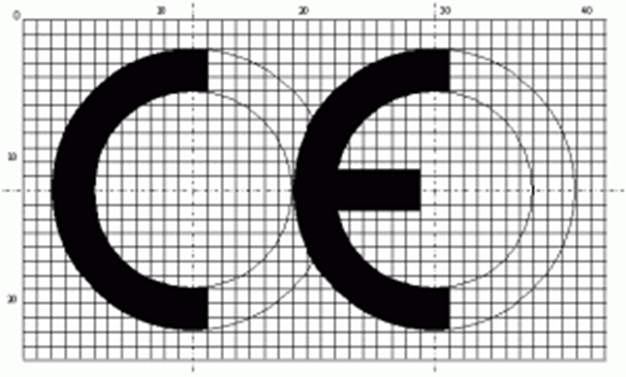
Affix the marking visibly, legibly and indelibly to the equipment or assembly, or its data plate. Where this is not possible or justified because of the product's nature, use the packaging and accompanying documents as required by the directive.
Keep the prescribed proportions and a minimum height of 5 mm. Where required, the identification number of the notified body involved in production control follows the CE marking.
Who is responsible for PED conformity?
The manufacturer is responsible for the design, manufacture, conformity assessment and declaration for the equipment or assembly it places on the market or uses for its own purposes. Importers, distributors and authorised representatives have their own duties and do not automatically replace that role.
What must an importer do?
Before placing equipment on the EU market, the importer must check that the manufacturer has completed the applicable assessment and that the required marking, identification, instructions and documentation are present.
The importer provides its contact details, keeps the EU declaration of conformity for ten years and ensures that the technical documentation can be made available to authorities. It must cooperate on corrective action where equipment does not comply or presents a risk.
What must a distributor do?
A distributor must act with due care, check the required marking and accompanying information, and ensure that storage or transport does not compromise conformity. Instructions and safety information must meet the destination market's language requirements. The distributor must not supply equipment it has reason to believe is non-compliant until the issue is resolved.
When does another operator become the manufacturer?
An importer or distributor assumes manufacturer obligations when it markets equipment under its own name or trade mark, or modifies it in a way that may affect conformity. Responsibilities therefore depend on the actual activity, not just the commercial job title.
What happens if equipment does not comply?
Authorities can require corrective action, restrict supply or order withdrawal or recall, depending on the issue and risk. Member States set penalties through national law. The applicable penalty depends on the country and circumstances; old fixed fine amounts are not a reliable guide for a current project.
Trusted by leading businesses. Chosen for results.














Your CE project. Expertly handled.
Scroll horizontally to compare the options.
Approach to CE marking
How the service works
Scope of support
Project contact
Product-specific assessment by experienced engineers
Engineering expertise combined with digital workflows
A complete project or selected tasks
A dedicated expert for your project
Other service providers
Approach depends on the provider and agreed scope
Processes vary between providers
Services depend on the provider and contract
Contact arrangements vary
CE software
Guided workflows based on the software functions
Your team enters information and assesses the results
Scope depends on the available modules
Technical support depends on the subscription
Practical engineering expertise
Successful projects. Results that speak for themselves.
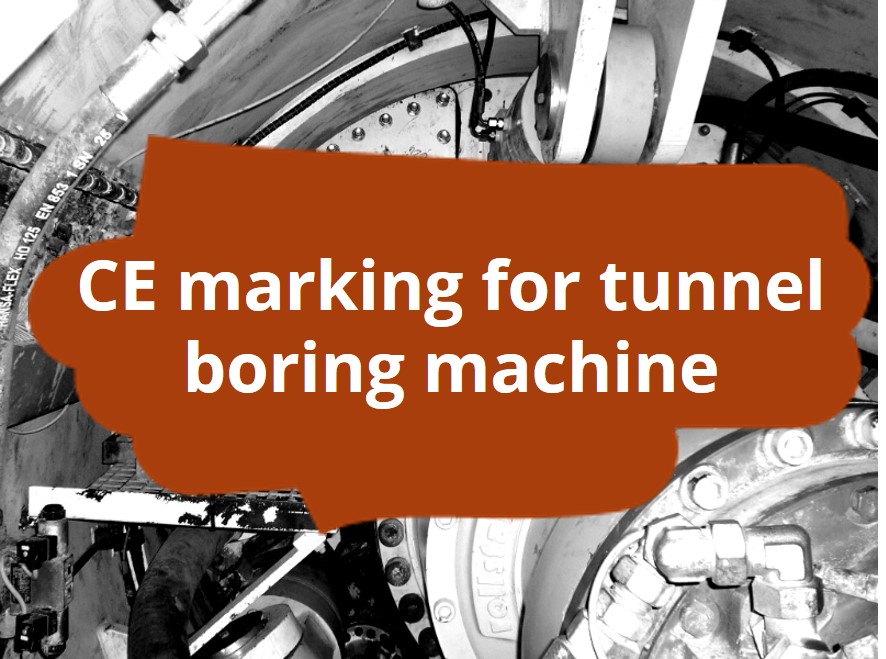
CE marking for a tunnel boring machine used in Australian copper mining
easyCE carries out the conformity assessment for a tunnel boring machine, including risk assessment across its lifecycle and preparation of a declaration of conformity ready to sign. The assessment focused on the new multi-arm cutting-head concept. The work also considered the applicable Australian safety and technical requirements, in close cooperation with the manufacturer and its Australian customer.
CE marking for control cabinets
easyCE supports the conformity assessment for control cabinets, including risk assessment and preparation of a declaration of conformity ready to sign. The assessment considered the Machinery, EMC and Low Voltage Directives, alongside DIN EN 60204-1:2019-06 and DIN EN IEC 61439-1:2021-10. The work also included a checklist to help select suppliers and components that meet the project's specific requirements.

CE marking for a mobile satellite communications system
easyCE supports the conformity assessment of a mobile satellite communications system, including risk assessment, EMC review and preparation of a declaration of conformity ready to sign. The system routes TCP/IP data redundantly through two or more satellite antennas. It is designed for rapid deployment where a mobile communications link is needed over long distances.
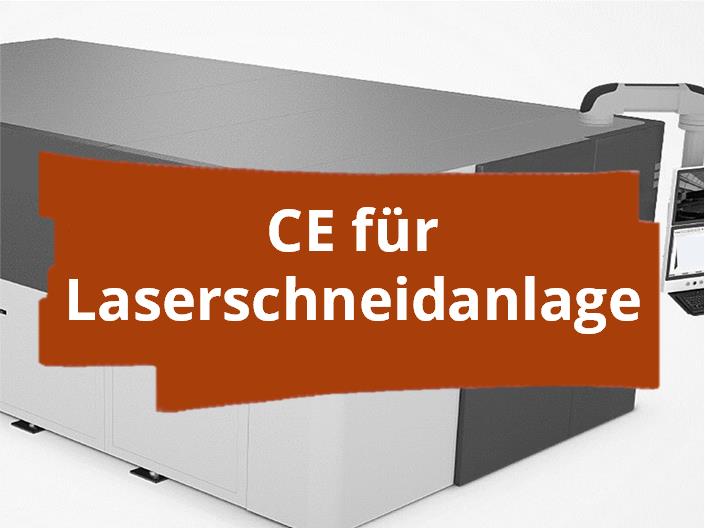
CE marking and declaration of conformity for a 2D laser cutting system
easyCE supports the full conformity assessment for a 2D laser cutting system with an automatic pallet changer. The work included coordinating the safety concept and two-beam light barrier, determining the performance level, analysing the product and carrying out a risk assessment in accordance with EN ISO 12100. Particular attention was needed for the cutting head's support structure and the movements of the pallet changer and cutting head. Laser protection screens, safety devices and a complete enclosure shield operators from the Class 4 laser cutting process inside the cabin, with Class 1 laser conditions outside the machine.
CE marking for a dual-robot welding system
easyCE assesses an automated welding system with two robot arms moving on a rail and prepares the declaration of conformity. The work addressed the combination of arc-stud and MAG welding, electrical equipment under EN 60204-1 and access to the work area. Door interlocking was assessed with reference to EN ISO 14119:2013.
Your project in three steps
Step 1
Discuss your product
Tell us about your product and request free initial advice. We identify the likely conformity requirements and the next steps for your project.
Step 2
Receive your proposal
We explain the required assessments and documentation, then prepare a proposal for the scope you need. You can commission a complete project or individual tasks.
Step 3
Your expert gets started
Your dedicated CE expert carries out the agreed engineering and documentation tasks and keeps you informed throughout the project. Follow-up questions can be discussed with the same expert.
Discuss your CE project
Product safety expertise

Willy Lebherz, Founder and Managing Director of easyCE
- Expert in product safety and conformity since 1995
- Recipient of the "Medal of the Order of Merit of the Federal Republic of Germany", awarded in 1983 by the then Federal President Carl Carstens
- Meister qualification in measurement and control technology
- Captain (ret.), Project Officer for Technical Logistics in the Army Material Office and Chief of the Telecommunications Repair Company
easyCE is an engineering consultancy specialising in product safety and conformity assessment. We help manufacturers, operators and suppliers assess products, reduce risks and prepare the documentation needed for market access. Our engineers identify applicable requirements, develop safety measures, prepare technical documentation and coordinate testing. You can commission the complete agreed process or selected tasks. Founded in southern Germany, easyCE works with clients internationally.
Technical expertise. Clear documentation. A defined route to conformity.