Choose the right CE or UKCA route for your product with easyCE.
Choose the right conformity route for your product and market.
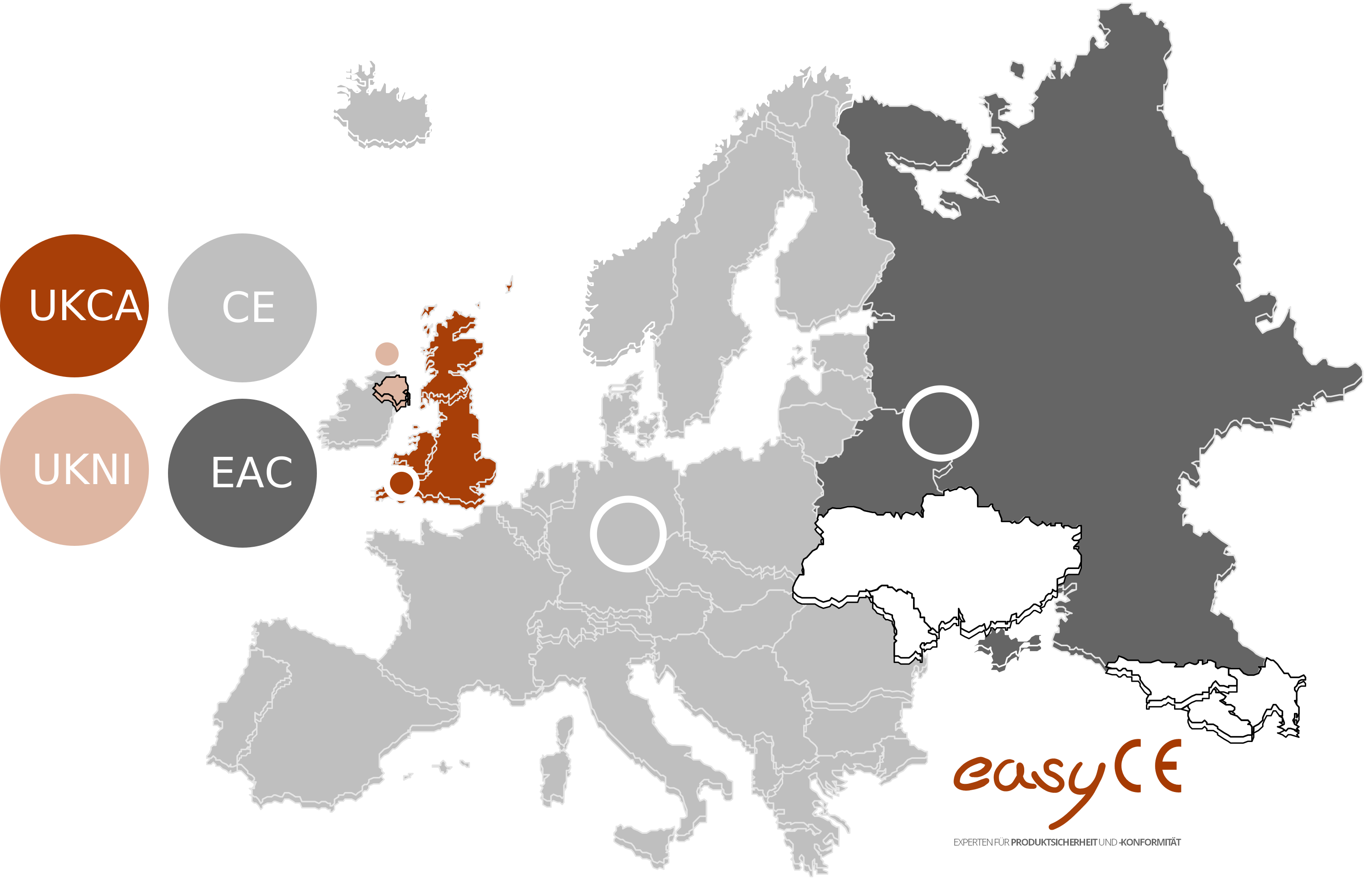
- easyCE assesses the requirements, reviews existing evidence and prepares the agreed technical documentation. We clarify whether you can use recognised CE compliance or need a UKCA route for your product.
- Great Britain means England, Scotland and Wales. Northern Ireland follows a separate product-marking framework.
- CE marking continues to be recognised in many sectors in Great Britain. Check the product-specific rules rather than relying on an old transition deadline.
- Where you choose UKCA, confirm the applicable procedure and declaration requirements before affixing the marking.
Discuss your product, intended markets and available documents with an easyCE expert.
Willy Lebherz
Managing Director, easyCE GmbH
Declaration prepared!
The declaration required for the selected conformity route, prepared for review and signature.
Risk assessment completed!
Product risks assessed and the relevant protective measures documented.
Requirements identified!
Applicable legislation and relevant standards identified for your product.
Documentation prepared!
Clear technical documentation and user instructions for the agreed scope.
Clear next steps!
Know what must be completed before affixing the appropriate marking.
Explore UKCA by topic
UKCA: the essentials
What does UKCA mean?
UKCA stands for UK Conformity Assessed. It is a product conformity marking for Great Britain where the relevant legislation provides for it. It is not a universal mark for all products or for the whole United Kingdom.
The manufacturer is responsible for ensuring that the product meets the applicable requirements. Complete the relevant assessment, documentation and declaration before using UKCA. The selected route may include an approved body where required.
Can products still use CE marking in Great Britain?
Yes, CE marking continues to be recognised for many regulated product sectors. The current rules do not impose one universal expiry date for that recognition. Some sectors have separate arrangements, so check the rules for your particular product rather than assuming that CE or UKCA is always accepted.
How does UKCA differ from CE marking?
The regimes refer to different legal frameworks and markets. Differences can include the declaration, responsible economic operators, standards references, identification details and conformity assessment bodies.
For relevant GB rules, independent assessment may involve a UK approved body. An EU notified body is used where required for the EU route. Available recognition and fast-track arrangements need to be checked for the product before deciding whether any existing assessment can be reused.
Can existing CE documentation be reused?
Existing risk assessments, drawings and test reports may support a UKCA assessment where they remain relevant. Review them against the actual requirements and product configuration rather than assuming that the two technical files are automatically identical.
Document any differences and identify the declaration and supporting records required by the selected route. This avoids unnecessary duplication while keeping each market's evidence traceable.
Which marking applies in Northern Ireland?
UKCA alone is not the conformity marking for Northern Ireland. For products covered by the relevant EU rules, CE marking applies. Where mandatory third-party assessment is carried out by a UK body for Northern Ireland, CE and UKNI are used together.
Products bearing CE and UKNI cannot use that combination for EU market access. Qualifying Northern Ireland goods have specific arrangements for access to Great Britain. Check both the destination and the assessment body involved.
Can CE and UKCA appear on the same product?
Yes, where the product fulfils the requirements for both and the markings are applied correctly. One mark must not obscure or undermine the other. Keep the relevant declarations and evidence consistent with the product supplied.
Which UK legislation applies?
Start with the sector-specific regulations for the product. Great Britain has product rules covering areas such as machinery, electrical safety, radio equipment and pressure equipment.
The Product Safety and Metrology (Amendment) Regulations 2024 provide continued CE recognition and fast-track UKCA arrangements for relevant sectors. Do not treat the earlier EU-exit amendments as the complete current rulebook. Check:
- The product scope and exclusions.
- The destination market and available conformity routes.
- Any required approved-body or notified-body involvement.
- The documentation, declaration and marking obligations.
- Several regulations can apply to one product. The assessment must address all applicable requirements, not just the most obvious product category.
Which standards are relevant?
UK designated standards can provide a presumption of conformity with the GB requirements they cover. For CE marking, the relevant references are EU harmonised standards published for the applicable legislation.
Check each published list, edition and restriction. A British or European standard is not automatically designated or harmonised for every legal purpose. Do not assume that future UK and EU lists will remain identical.
What should manufacturers and importers check?
Identify the roles and obligations in the actual supply chain. In particular:
- A GB importer has responsibilities under the relevant sector rules, including checks and identification information. Confirm the current rules for where that information may appear.
- An authorised representative acts under a written mandate and must meet the applicable establishment requirements. Appointment does not transfer all of the manufacturer's responsibilities.
- An EU business importing products from Great Britain may have importer obligations rather than only distributor duties. Assess the EU and GB supply chains separately, including document access, identification and corrective action.
Does Regulation (EU) 2019/1020 affect exports to the EU?
Regulation (EU) 2019/1020 concerns EU market surveillance, not the UKCA marking itself. Its economic-operator requirements are relevant when supplying products within its scope to the EU.
For products covered by Article 4, the required tasks must be fulfilled by a qualifying economic operator established in the EU. Depending on the supply chain, this can be the EU manufacturer or one of the following:
- An importer.
- An authorised representative with the necessary written mandate.
- A fulfilment service provider where the conditions in Article 4 are met and no other qualifying operator is established in the EU.
Trusted by leading businesses. Chosen for results.














Choose the right support for your project
Scroll horizontally to compare the options.
Approach to product conformity
How the work is carried out
Scope of support
Your point of contact
A product-specific route based on the applicable requirements
Existing CE evidence reviewed for the selected UKCA route
An agreed overall scope or selected individual tasks
A dedicated expert who knows your project
Other service providers
Approach depends on the provider and agreed service
Delivery methods vary between providers
Scope defined by the service agreement
Contact arrangements depend on the provider
CE software
Tools organise assessments and documentation
Your team supplies the technical input and uses the tools
Features depend on the selected software and modules
Expert assistance depends on the service package
Technical expertise. A clear plan.
Get started in three steps
Step 1
Get free initial advice
Tell us what your product does, where you plan to supply it and what evidence you already have. An expert will discuss the relevant requirements and next steps with you, free of charge.
Step 2
Receive your proposal
We prepare a proposal defining the work, required inputs and deliverables. Your expert explains the selected conformity route and any outstanding assessment or documentation tasks.
Step 3
Start the agreed work
Your dedicated expert carries out and coordinates the agreed technical and documentation work. We explain the results and outstanding actions at handover. Any ongoing updates or additional services are agreed separately.
Prepare your product for its market
Your experts in product safety and compliance

Willy Lebherz, Founder and Managing Director of easyCE
- Product safety and compliance expert since 1995
- Recipient of the "Medal of the Order of Merit of the Federal Republic of Germany", awarded in 1983 by the then Federal President Carl Carstens
- Meister qualification in measurement and control technology
- Retired captain, former technical logistics project officer and commander of a telecommunications repair company
easyCE is an engineering consultancy specialising in product safety and compliance. We work with manufacturers, machinery users and distributors on risk assessments, standards research, protective measures and technical documentation. Our experts also coordinate required testing and other agreed conformity assessment tasks. You can commission an overall project scope or individual services. Founded in southern Germany, easyCE works with clients internationally.
Technical expertise, clear documentation and an agreed plan for your UKCA project.